
The digital economy is accelerating at a pace that physical infrastructure can no longer support. As artificial intelligence (AI), machine learning, and cloud architectures demand unprecedented amounts of power, Europe’s data centre operators face a common, systemic bottleneck: the electrical grid. While the technology inside facility walls advances in cycles of months, upgrading the high-voltage transmission lines outside takes years, sometimes decades.
According to data compiled by industry groups like the European Data Centre Association (EUDCA), growth is increasingly constrained not by capital or customer appetite, but by energy availability, grid readiness, and permitting complexity. This structural mismatch has created an interconnection crisis where data centre developers can face multi-year connection delays.
For operators and their capacity-hungry customers waiting passively for a standard grid connection is no longer a viable business strategy. Managing power infrastructure will be the defining theme at Data Center World Europe in Vienna this October.
The Scale of the Problem: Multi-Year Grid Queues in European Markets
The queue to connect to Europe’s electrical grids has grown from an administrative hurdle into a major commercial risk. Across the continent, transmission system operators (TSOs) are overwhelmed by simultaneous requests from renewable energy projects, industrial electrification, and data centre developments.
The timeline to secure significant power allocations now routinely stretches between seven to twelve years for larger projects. Research published by Resource Recovery UK (RRUK) highlights that standard grid connections for major industrial compute facilities face these extensive backlogs due to physical grid capacity shortages. TSOs must build new substations, upgrade transformers, and string hundreds of kilometres of high-voltage lines to handle the massive, concentrated loads that modern data centres require.
As a result, regulators are moving away from traditional 'first-come, first-served' queuing systems. In its landmark May 2026 report, grid utility association ENTSO-E actively advocated for reformed allocation processes. This regulatory shift rewards project maturity over speculative queue holding. Operators who cannot prove their project is ready to build risk losing their spot in line to more advanced projects.
For example, Germany, one of Europe's leading data centre hubs, has adopted a new Data Centre Strategy which includes a new maturity model to replace the first-come first-served connection system.
Why FLAP-D Hubs Are Becoming Harder to Scale in
For over two decades, data centre deployment has concentrated in the FLAP-D markets (Frankfurt, London, Amsterdam, Paris, and Dublin). However, these tier-1 connection hubs are facing severe energy resource constraints. Data from CBRE’s Global Data Centre Trends report confirms that FLAP-D markets are heavily plagued by grid infrastructure constraints, driving up construction and rental costs.
Beyond power shortages, these markets face a lack of available land near existing substations. Environmental regulations, noise ordinances, and municipal resistance make securing permits a long, unpredictable process. While FLAP-D remains critical for low-latency applications, building large-scale, multi-megawatt facilities there is becoming increasingly difficult and expensive.
Can Behind-the-Meter Solutions Fill the Gap?
To continue expanding, operators are taking power generation into their own hands through behind-the-meter (BTM) solutions. By colocating energy generation directly with the data centre, facilities can operate independently of the wider grid transmission capacity.
On-site generation offers a distinct advantage; speed to market. In Ireland, major operators have successfully deployed over 620 MW of operator-provided generation across four Dublin-area projects. Companies like EdgeConneX have executed this localised approach, deploying on-site gas generation infrastructure directly adjacent to engine buildings to keep facilities compute-ready while transmission substations remain disconnected in the background.
However, BTM generation has its own limitations. The capital expenditure required to build a private utility plant alongside a data centre changes the project's financial profile. Fuel logistics present another challenge; securing a continuous supply of natural gas or sourcing green hydrogen at scale, requires complex supply chains. Furthermore, local emissions regulations remain strict. Even clean-burning natural gas turbines face scrutiny from municipal planning boards focused on local air quality and carbon reduction targets. Consequently, BTM generation is rarely a permanent substitute for the grid. Instead, it serves as a bridge solution to ensure near-term operational readiness.
Evolving Collaboration with Utility Operators and Energy Providers
Solving the interconnection crisis can't be the responsibility of any one player or community but requires a shift in relationship with utility operators and energy providers from adversarial or transactional to strategic collaboration.
The ENTSO-E guidelines emphasise that data centres must evolve from passive energy consumers into active system-support assets. Analysis from Ember Energy demonstrates that data centre flexibility can unlock grid capacity through targeted grid connection agreements.
One major area of collaboration is demand-response and grid flexibility. Modern data centers equipped with large-scale battery energy storage systems (BESS) do not just draw power, they can also feed it back or lower their intake during peak grid stress. By participating in frequency regulation and balancing markets, data centers help stabilize the grid, making utilities more willing to approve their connection requests. The UK's National Grid estimates that flexible operation across the UK's data centre pipeline could provide 2GW of availability.
Operators are also co-investing directly in utility infrastructure. Rather than waiting for a TSO to fund a local substation upgrade through its standard budget cycle, operators are increasingly offering to split the cost or front the capital entirely. This financial collaboration speeds up construction timelines and creates dedicated transmission capacity, showing that data centres can be an asset to grid development rather than just a burden.
The Role of Northern, Southern and Eastern Europe in Fuelling Future Expansion
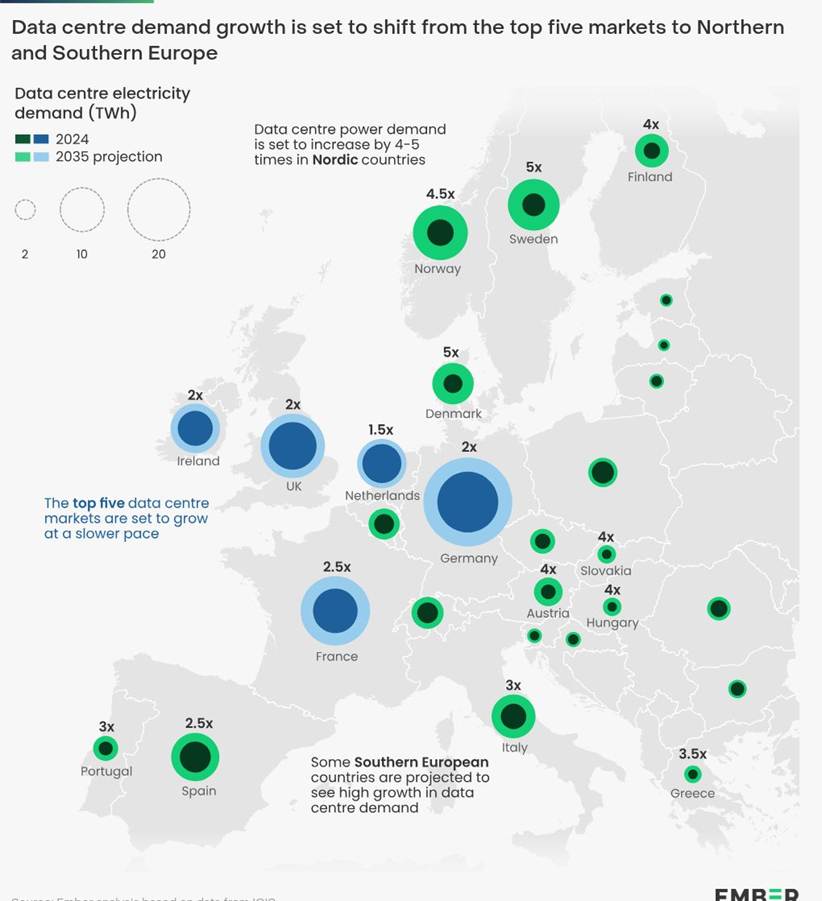
As FLAP-D markets face increasing constraints, the geography of European data centre development is shifting. Capital and capacity are moving to secondary and tertiary markets in Southern, Northern, and Eastern Europe, where power is more accessible, affordable, and often cleaner.
Spain and Portugal are absorbing the largest share of this detour. The Aragon region in Spain has absorbed over $60 billion in data centre development due to massive solar and wind surpluses. Data from Portuguese grid operator REN and utility EDP shows electricity demand growing at 4.5% annually through 2035 driven almost entirely by a 2.6 GW data centre pipeline, led by projects like the 1.2 GW Start Campus in Sines.
The Nordics attracted over $15 billion in investment recently. Facilities like EcoDataCenter 1 in Falun, Sweden, demonstrate the power of local energy synergies, running a 90 MW hyperscale campus on 100% renewable energy (75% hydropower, 25% wind) while maintaining a low PUE of 1.2 through natural ambient cooling.
Eastern Europe is seeing its share of new investment too. Poland has exceeded $6 billion in digital infrastructure spending driven by a national grid utility expansion. ClusterPower is deploying an 800MW AI data centre in Romania, while Pantheon is building Europe's next major AI campus in Croatia.
Source: Ember Energy
Can Tapping Stranded Power through Brownfield Redevelopment Be a Quick Solution?
Grid partnerships, BTM deployments and expansion into energy-rich markets are all viable strategies for overcoming energy access limitations. But for operators seeking an alternative solution, brownfield redevelopment is also becoming an attractive option.
Decommissioned coal-fired power plants, older manufacturing facilities, and heavy industrial parks often possess the exact asset data centres need most; an existing, high-capacity connection to the high-voltage transmission grid. Reusing a site that already has 100MW of grid allocation allows operators to bypass the multi-year TSO connection queues entirely.
Major utilities are capitalising directly on this trend. According to a Reuters sustainability report, global energy giants including Engie, Iberdrola, EDP, EDF, and Enel are actively marketing old gas and coal sites for new data centre development. Operators are already capitalising on this opportunity, such as Era4 in the UK who is building a modular data centre on the site of an old steel plant in South Wales.
Not only does this provide quick access to powered land, but it also brings much-needed investment and development into post-industrial communities that are often some of the poorest areas in Europe. Brownfield redevelopment can help alleviate growing community pushback, if paired with other local investment initiatives such as local workforce development opportunities and supplier sourcing.
However, brownfield redevelopment comes with its own challenges. A PwC report on industrial redevelopment highlight that, while the benefits often outweigh the challenges, these projects often face high land prices, engineering and construction challenges, and building restrictions based on existing land and energy infrastructure.
Shaping the Energy Strategy at Data Center World Europe
The relationship between the data centre and the electrical grid has fundamentally changed. Power procurement is no longer just a utility expense; it is now a core strategic challenge that dictates where, when, and how facilities can be built.
These challenges will be a central focus at Data Center World Europe in Vienna this October (13-14th). As part of our dedicated conference track, 'Securing & Deploying Energy,' industry leaders will gather to discuss these issues to share practical insights, explore new technologies, and build the partnerships needed to navigate Europe's grid constraints.
Do not wait for the grid to come to you. Join the conversation in Vienna and help shape a more resilient energy strategy for Europe’s data centre ecosystem.